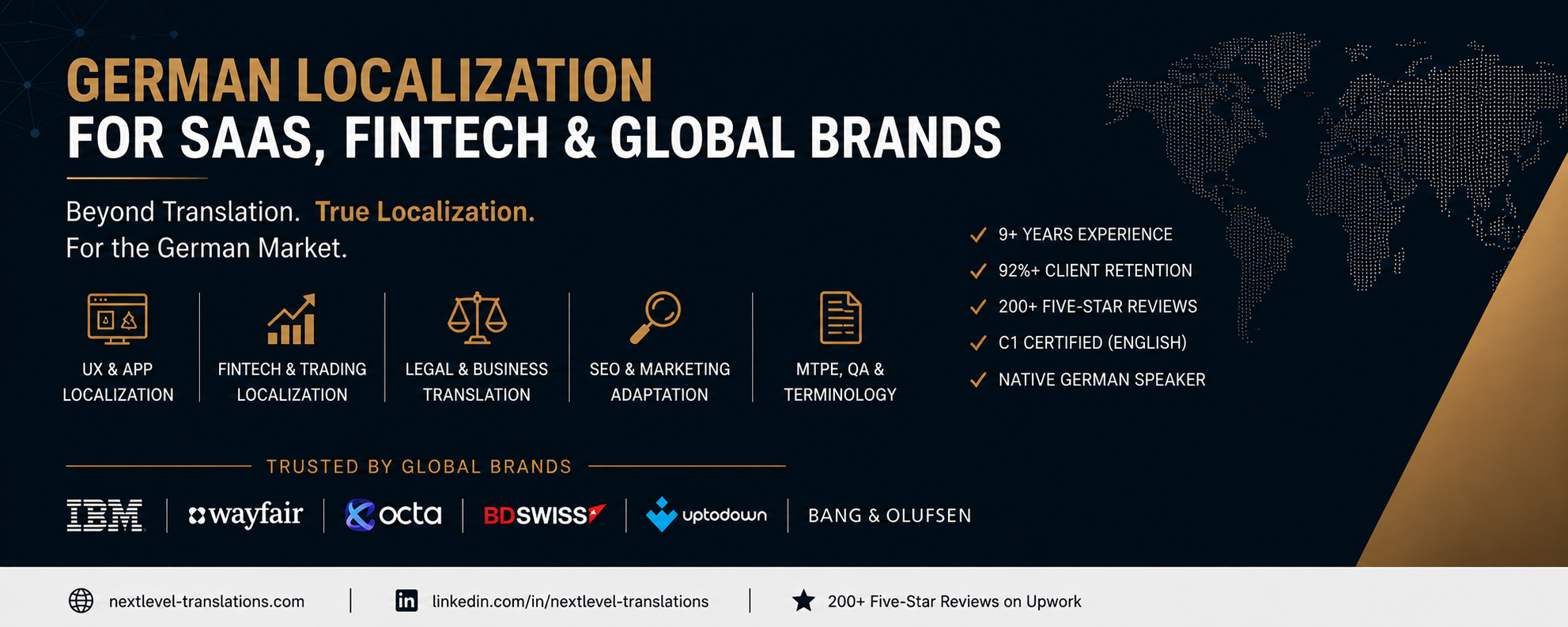
High-precision German proofreading, MTPE, and linguistic QA for flawless localization.
I help companies ensure that their German content is not only correct, but consistent, natural, and production-ready across all touchpoints.
From machine translation post-editing (MTPE) to detailed linguistic QA and final proofreading, I refine content so it meets the highest standards of clarity, accuracy, and user experience — especially in SaaS, fintech, and digital product environments.
Because in localization, small errors are never just “small” — they affect trust, usability, and perception.
Why Proofreading & QA Matter
Even the best translation workflows produce inconsistencies, especially at scale.
Without proper proofreading and QA, localized content often suffers from:
- inconsistent terminology across product interfaces
- unnatural phrasing that reduces readability
- UX copy that feels “translated” instead of native
- formatting or structural issues in UI text
- subtle meaning shifts introduced by MT systems
- tone inconsistencies across different content types
For German users, these issues are particularly noticeable. German readers expect linguistic precision, clear structure, and consistent terminology — especially in SaaS, fintech, and technical environments.
Proofreading and QA are not just final steps in the process. They are the safeguard that ensures your product feels coherent, trustworthy, and professionally localized.
Common Issues in MTPE & Localization QA
Machine translation and fast-paced localization workflows often introduce predictable quality issues.
Here are the most common ones I encounter:
1. Literal MT output that ignores context
Machine translations often miss UX context, resulting in awkward or misleading phrasing.
2. Inconsistent terminology across systems
UI, documentation, and marketing content often use different German terms for the same concept.
3. Tone mismatch in user-facing content
German output may be too formal, too literal, or simply not aligned with product voice.
4. Broken UX flow in interface text
Strings that are technically correct but disrupt readability or user interaction.
5. Lack of linguistic nuance
Subtle meaning differences are often lost in automated or rushed translation pipelines.
6. QA gaps in large-scale localization projects
Errors that only become visible when content is reviewed in context across multiple screens or flows.
These issues are often invisible in isolation — but highly impactful in real product usage.
My Experience in Proofreading, MTPE & QA
I have extensive experience working on high-volume localization projects where consistency and quality control are critical.
In long-term collaborations with international platforms and SaaS companies, I’ve been responsible not only for translation and post-editing, but also for linguistic QA, DQF-style reviews, and evaluation of large-scale localized content systems.
Clients consistently highlight my ability to identify subtle linguistic issues that affect clarity and user perception — especially in UX and product environments where wording directly influences behavior.
My work is often used in fast-paced environments with strict deadlines, where quality cannot slow down delivery. In these contexts, reliability, consistency, and structured feedback are essential.
In addition to proofreading and MTPE, I have also contributed to improving translation workflows themselves — including refining glossaries, optimizing translation memories, and providing feedback on other translators’ output to improve overall team performance.
One recurring theme in feedback is that my revisions do not just “correct errors” — they improve readability, flow, and naturalness in German while preserving intent and technical accuracy.
Workflow & Tools
My QA and MTPE workflow is structured around ensuring both linguistic precision and product usability.
I typically work in three stages:
1. Linguistic Review (MTPE or Human Translation)
I evaluate the source output for meaning accuracy, terminology usage, and grammatical correctness, ensuring that nothing is lost or distorted in translation.
2. Contextual QA (UX & Product Level)
I review content in context — especially UI strings, onboarding flows, and product interfaces — to ensure readability, flow, and consistency across screens and user journeys.
3. Consistency & System QA
I check terminology consistency across:
- UI and product text
- marketing content
- help center and documentation
- internal glossaries and translation memories
This step is especially important in large SaaS and fintech environments where multiple content streams converge.
I regularly work with MTPE workflows, structured QA frameworks (including DQF-style evaluations), and collaborative tools that allow for fast iteration and feedback loops with localization teams.
The goal is always the same: deliver German content that feels consistent, natural, and production-ready — regardless of scale or source quality.
Industries I Work With
My proofreading, MTPE, and QA work spans multiple industries where linguistic precision directly impacts user trust and product performance.
SaaS & Digital Platforms
UI content, onboarding flows, feature descriptions, and help documentation requiring consistent terminology and UX clarity.
Fintech & Financial Services
High-precision content where small linguistic inconsistencies can affect trust and comprehension.
E-Commerce & Digital Services
Product descriptions, checkout flows, and transactional messaging where clarity directly influences conversion.
Localization Agencies & Global Teams
Large-scale translation workflows requiring QA, MTPE, and consistency control across multiple linguists and systems.
Across all industries, one principle remains constant: quality is not just about correctness — it is about consistency, clarity, and user experience at scale.
FAQ
What is the difference between proofreading and MTPE?
Proofreading focuses on correcting human-translated content, while MTPE involves refining machine-generated translations into natural, high-quality German.
Do you also work on large-scale QA projects?
Yes. I regularly work on high-volume localization projects where consistency across thousands of strings is required.
Can you improve existing translation systems?
Yes. I often help refine glossaries, translation memories, and terminology systems to improve long-term quality.
Do you review content in context?
Yes. Contextual QA is a core part of my workflow, especially for SaaS and UI localization projects.
Looking for reliable German proofreading and localization QA?
I refine machine translations and human content to ensure linguistic accuracy, consistency, and a natural native-level tone.