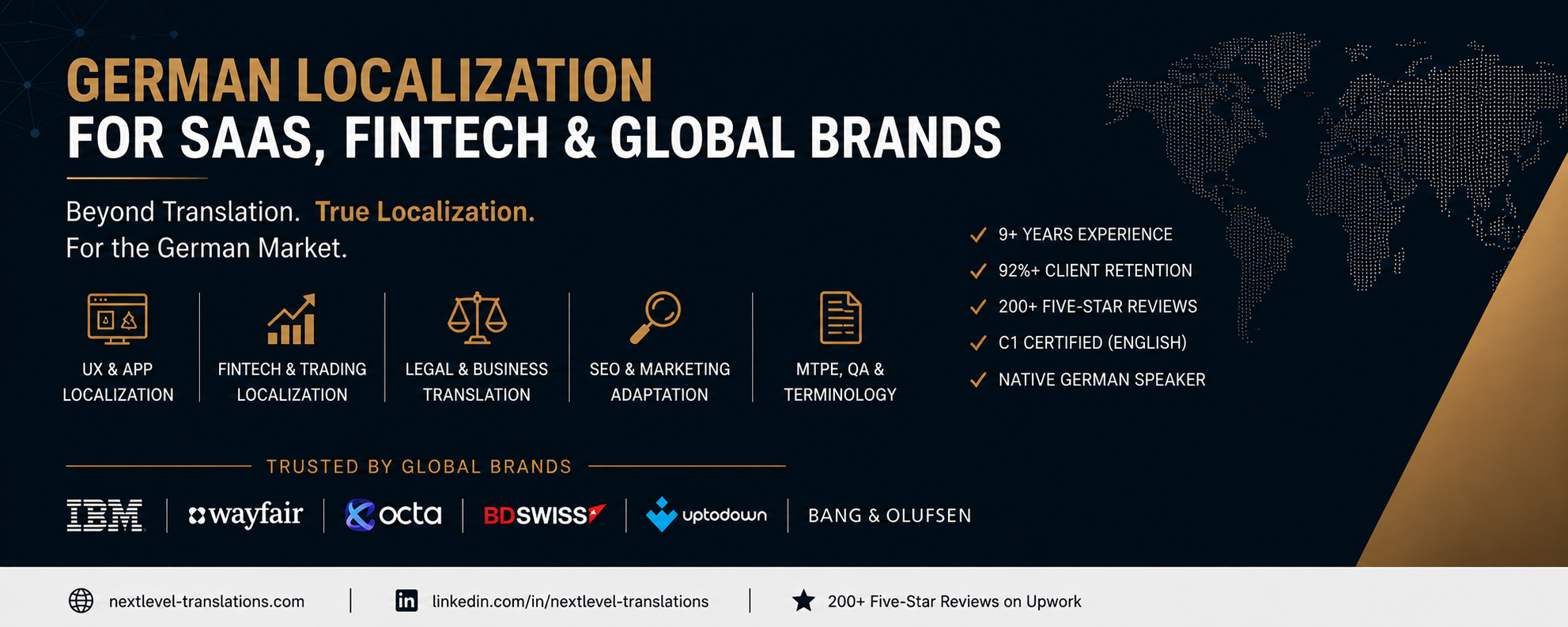
German marketing localization that ranks, converts, and sounds truly native.
I help SaaS and digital companies adapt their marketing and SEO content for German-speaking audiences in a way that goes beyond translation — focusing on search performance, conversion clarity, and cultural relevance.
From landing pages and ads to SEO-driven content strategies, I ensure your message not only reaches German users, but actually resonates with them and drives action.
Because in marketing localization, sounding “correct” is not enough — it needs to perform.
Why SEO & Marketing Localization Matters
Marketing content behaves differently across languages — especially in German.
Direct translation often destroys the persuasive structure of copy, weakens emotional triggers, and reduces SEO performance. Even if users understand the message, they don’t necessarily feel compelled to act.
In the German market, successful marketing localization must balance three things:
- Search intent alignment (SEO relevance)
- Cultural and linguistic naturalness
- Conversion-focused messaging
If any of these elements are missing, performance drops.
Poorly localized marketing content often leads to:
- lower organic rankings in German search results
- reduced CTR from meta titles and descriptions
- weaker landing page conversion rates
- inconsistent brand voice across channels
- loss of persuasive impact in ad copy
German users are particularly sensitive to clarity, structure, and credibility — especially in B2B and SaaS contexts. That means marketing copy must be both precise and persuasive at the same time.
Common Localization Problems in Marketing Content
Marketing localization fails most often when companies treat it as translation instead of adaptation.
Here are the most common issues I see:
1. Literal keyword translation (SEO failure)
Keywords are translated directly instead of being adapted to actual German search behavior.
2. Loss of persuasive structure
English copywriting frameworks (like AIDA or PAS) often break when translated word-for-word into German.
3. Weak or unnatural CTAs
Calls-to-action lose urgency or feel unnatural in German, reducing conversion performance.
4. Mismatch between SEO intent and copy
Content may be linguistically correct but does not align with how German users actually search.
5. Overly long or clunky German phrasing
Marketing copy becomes heavy, reducing readability and engagement.
6. Inconsistent tone across channels
Landing pages, ads, and emails often feel like different brands due to inconsistent localization.
These issues directly affect both organic visibility and paid campaign performance.
My Experience in SEO & Marketing Localization
I specialize in adapting marketing and SEO content for German-speaking audiences with a strong focus on performance, clarity, and conversion impact.
My work includes localizing landing pages, SaaS marketing websites, product messaging, ad copy, and SEO content strategies for international companies entering the German market.
Across long-term collaborations, clients consistently highlight that my translations feel natural, structured, and conversion-oriented — not like translated marketing copy, but like content originally written for German users.
I’ve worked extensively on UX-facing marketing content where clarity and persuasion must work together — from pricing pages and feature descriptions to onboarding messaging and campaign landing pages.
One recurring strength mentioned in client feedback is my ability to maintain both linguistic precision and marketing impact under tight deadlines, especially in fast-moving SaaS and digital product environments.
Workflow & Tools
My workflow for SEO and marketing localization is built around one principle: performance-driven adaptation, not literal translation.
I start by analyzing the marketing intent behind the content:
- Is the goal SEO visibility, conversion, or brand positioning?
- What is the target user intent in German search behavior?
- How does the message need to change to feel persuasive locally?
From there, I adapt content across three layers:
1. SEO Localization Layer
I adapt keywords based on real German search behavior, not literal translation — ensuring alignment with actual search intent and SERP expectations.
2. Conversion Copy Layer
I restructure marketing messages to improve clarity, persuasion, and CTA effectiveness in German.
3. Brand Voice Layer
I ensure consistency across landing pages, ads, emails, and product messaging so that the German brand experience feels unified.
In practice, I often work with:
- SEO briefs and keyword sets
- Landing page wireframes
- Ad copy variations (Google, Meta, LinkedIn)
- SaaS marketing funnels
- Content optimization cycles based on performance feedback
Tools and workflows include collaborative platforms like Notion, Figma, and shared SEO/translation environments, as well as glossary systems for brand and product consistency.
Industries I Work With
I primarily work with digital-first companies where marketing performance depends heavily on localization quality.
SaaS & B2B Tech
Landing pages, feature pages, and SEO-driven content strategies for international SaaS products.
Fintech & Financial Services Marketing
Performance-driven messaging for financial products where clarity and trust are essential.
E-Commerce & D2C Platforms
Marketing content, product pages, and campaign localization focused on conversion optimization.
Growth & Performance Marketing Teams
Ad creatives, landing page optimization, and multilingual SEO content strategies.
Across all industries, the common factor is clear: marketing localization directly impacts revenue. It is not just communication — it is performance infrastructure.
FAQ
Is marketing localization the same as translation?
No. Marketing localization adapts messaging for search intent, cultural context, and conversion behavior — not just language.
Can you work with existing SEO keywords?
Yes. I often refine or adapt keyword strategies to better match German search behavior and improve ranking potential.
Do you also localize ads and campaigns?
Yes. I work on both organic SEO content and paid marketing assets like ad copy and landing pages.
How do you ensure conversion performance?
By adapting structure, tone, and CTA logic specifically for German user expectations and testing alignment with intent-driven messaging.
Looking for German localization that actually performs in search and marketing?
I adapt your content so it doesn’t just translate well – it ranks, converts, and feels native to German-speaking audiences.