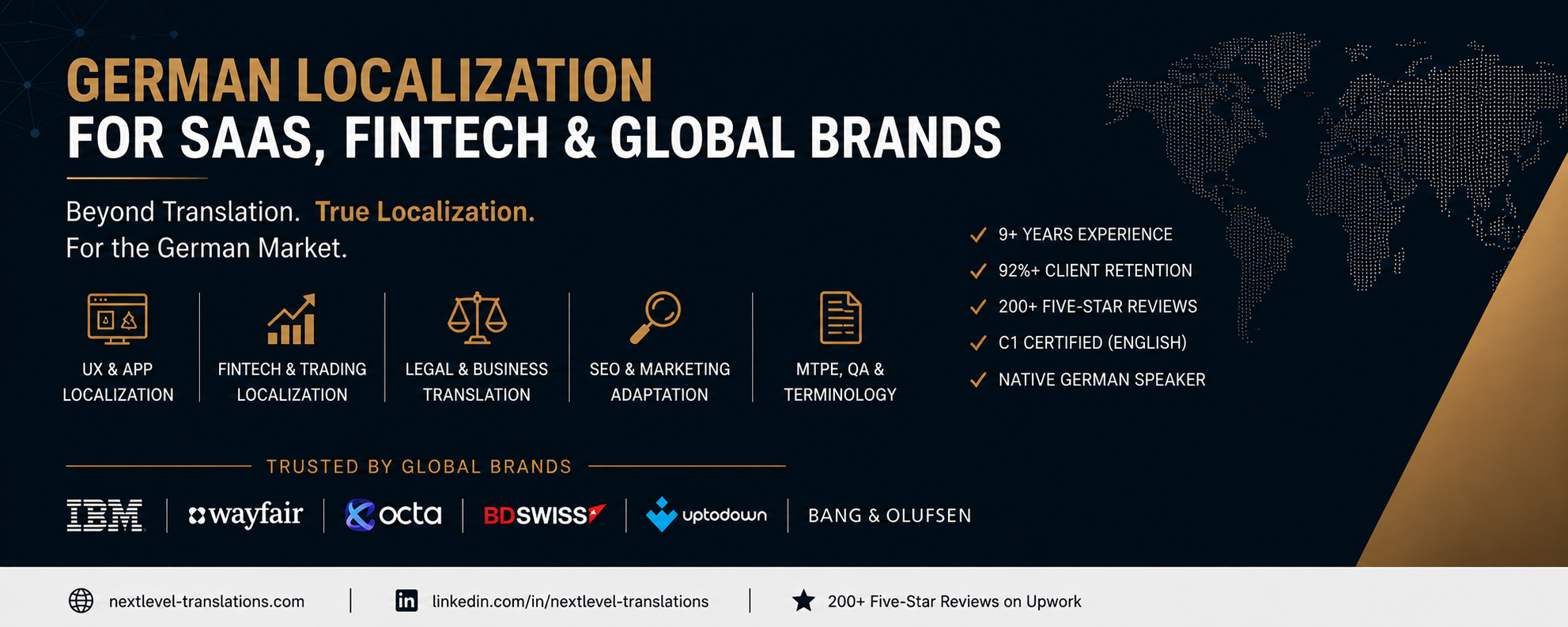
German SaaS Localization that feels native, not translated.
I help SaaS companies localize their products and websites into German with a focus on clarity, usability, and conversion. My goal is simple: your German users should feel like your product was built for them from day one — not adapted after the fact.
Whether you’re launching in Germany for the first time or improving an existing localization, I make sure your UX copy, onboarding flows, UI strings, and marketing pages sound natural, intuitive, and trustworthy in German.
Why SaaS Localization Matters
Expanding into the German market is not just a translation exercise — it’s a product experience challenge.
German users tend to have high expectations when it comes to clarity, structure, and precision. If your SaaS product feels even slightly “translated,” it can directly affect:
- User activation rates
- Trial-to-paid conversion
- Customer trust and retention
- Support ticket volume
- Brand perception in the DACH market
A well-localized SaaS product does more than communicate meaning. It reduces friction.
When localization is done right, German users don’t notice it. They simply understand your product faster, trust it more, and adopt it more naturally.
That is the difference between translation and true SaaS localization.
Common Localization Problems in SaaS Products
Many SaaS companies underestimate how different German UX expectations are compared to English-first products.
Here are the most common issues I see:
1. Literal translations that break UX flow
UI strings are translated word-for-word, resulting in unnatural phrasing that feels heavy or awkward in German interfaces.
2. Inconsistent terminology across the product
The same feature is labeled differently across UI, onboarding emails, and help center content. Inconsistent terminology across the product often leads to confusion in user flows and requires structured quality control across all localized content.
3. Overly long German UI strings
German tends to expand text length, which can break layouts if not adapted properly.
4. Tone mismatch
English-friendly casual tone is often either too informal or too stiff when directly translated into German.
5. Marketing copy that loses persuasive impact
Landing pages and pricing pages often fail to convert because the emotional and persuasive nuance is lost in translation.
6. Ignoring German user expectations
German users expect precision, transparency, and structure — especially in SaaS onboarding and pricing communication.
These issues may seem small individually, but together they can significantly reduce product performance in the German market.
My Experience in SaaS & Website Localization
I have been working as a German localization specialist since 2017, with long-term collaborations across SaaS, digital platforms, and global tech companies. Over the years, I’ve become a trusted partner for teams that need more than just translation — they need consistency, reliability, and product-level understanding of language.
One of the most important aspects of my work is long-term collaboration. I’ve been working continuously with clients since 2021 who rely on me for UX copy, website localization, app content, and market-facing materials such as reports and guides. In these partnerships, reliability is not an extra — it’s the baseline. Deadlines are consistently met, workflows run smoothly, and communication stays clear and proactive.
Beyond SaaS UX and product content, I also regularly work on more complex linguistic tasks such as subtitle translation, captioning, and proofreading for international media projects and enterprise-level content. These projects require not only linguistic precision but also a strong sense of tone, timing, and audience adaptation.
Across all collaborations, a consistent theme emerges: my work is described as accurate, natural-sounding, and highly dependable — especially in fast-paced environments where quality and speed need to go hand in hand.
Workflow & Tools
A structured workflow is essential for high-quality SaaS localization. My process is designed to integrate smoothly into product teams and development cycles.
1. Content Analysis
I start by reviewing your existing product content, identifying inconsistencies, UX issues, and localization risks.
2. Terminology Alignment
I define or align key terminology to ensure consistency across UI, marketing, and support content.
3. UX-Focused Localization
Instead of literal translation, I adapt content based on:
- UI context
- User journey stage
- Conversion goals
- German linguistic patterns
4. QA & Consistency Check
All localized content is reviewed for:
- Linguistic accuracy
- UX clarity
- Tone consistency
- Layout compatibility
Tools I typically work with:
- CAT tools (e.g. SDL Trados, CrowdIn, Smartcat, etc.)
- Figma (for UI context)
- Notion / Docs for collaboration
- Glossaries & style guides
- QA checklists for consistency
Across all workflows, feedback loops are a key part of my process. I’m used to working in environments where iterations are fast, priorities shift quickly, and clarity in communication is essential for delivering high-quality results under tight deadlines.
The goal is always the same: a scalable localization system, not one-off translations.
Industries I Work With
Over the years, I’ve worked with a wide range of digital-first companies, with a strong focus on SaaS, platform-based businesses, and international tech products.
A large part of my experience comes from SaaS and digital platforms where I handle UI localization, onboarding flows, marketing pages, and product descriptions. These environments require not only linguistic accuracy but also a deep understanding of user journeys and conversion-oriented writing.
I’ve also worked extensively with e-commerce and digital service platforms, where localization directly impacts customer trust and purchasing decisions. In these contexts, clarity and consistency are especially important, as users often interact with large volumes of structured content.
Across all industries, the pattern remains the same: the most successful localization projects are those where language is treated as part of the product experience — not just an afterthought.
FAQ
Do you translate or localize SaaS products?
I focus on localization rather than literal translation. This means adapting content for German UX expectations, not just converting language.
Can you work with existing translations?
Yes. I often review and improve existing German translations, especially in SaaS products where inconsistency or unnatural phrasing is an issue.
Do you handle both product UI and marketing pages?
Yes. I work across the entire user journey — from UI strings to landing pages and onboarding flows.
How do you ensure consistency?
I use terminology systems, style guides, and contextual review across all product areas to ensure consistent language usage.
Do you work with early-stage startups?
Yes. Early localization is often the most impactful, because it prevents scaling issues later in the product.
Looking for professional German SaaS localization?
I help SaaS companies create intuitive, natural user experiences for German-speaking markets that feel like they were built locally from day one.