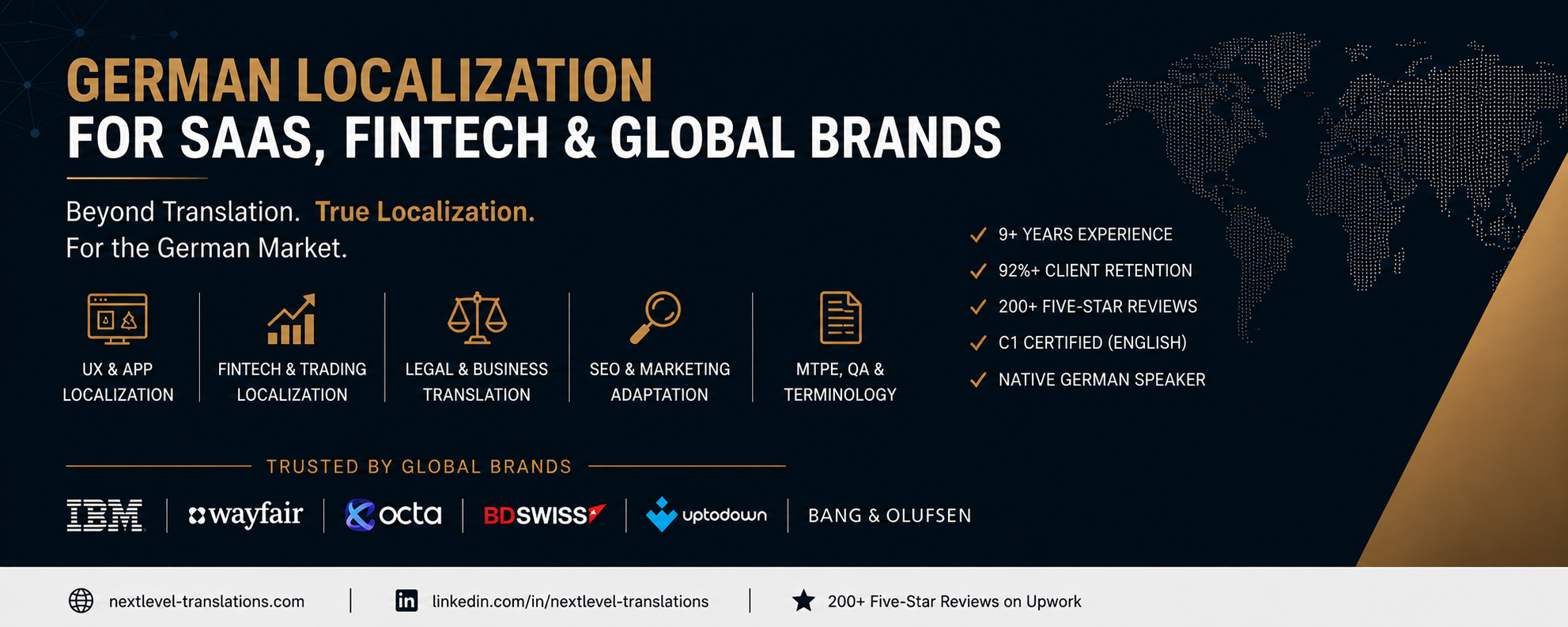
Precise German fintech localization that builds trust and meets expectations.
I help fintech companies and financial service providers localize their products, platforms, and customer communication for the German market with a focus on clarity, regulatory sensitivity, and user trust.
In fintech, language is not just UX — it directly affects credibility. Whether it’s onboarding flows, financial reports, dashboards, or customer communications, every word must be precise, consistent, and easy to understand.
My goal is to make your financial product feel reliable and transparent to German users from the very first interaction.
Why Fintech Localization Matters
The German financial market is one of the most demanding in Europe when it comes to clarity, structure, and linguistic precision.
Users expect financial products to be:
- extremely clear in meaning
- consistent across all touchpoints
- transparent in pricing and communication
- aligned with regulatory expectations
- free of ambiguity or “marketing-style” wording
Even small inconsistencies in wording can significantly impact trust. In fintech, trust is not optional — it is the foundation of conversion and retention.
A poorly localized fintech product can lead to:
- reduced onboarding completion rates
- lower user trust in financial processes
- increased support requests
- misunderstandings in pricing or features
- compliance risks in regulated messaging
High-quality fintech localization ensures that users feel secure, informed, and confident when interacting with your product.
Common Localization Problems in Fintech Products
Fintech localization is especially sensitive because it sits at the intersection of UX, law, and finance.
Some of the most common issues I encounter include:
1. Ambiguous financial terminology
Terms are often translated too loosely, leading to confusion in key financial processes.
2. Inconsistent wording across critical flows
Onboarding, verification, and payment flows often use different terminology for the same concepts.
3. Overly marketing-driven language
Financial products sometimes rely on persuasive phrasing that weakens trust in regulated environments.
4. UX copy that ignores German precision standards
German users expect structured, formal clarity — especially in financial contexts.
5. Poor adaptation of legal or compliance-related text
Legal disclaimers or financial explanations are often translated without considering readability and user comprehension.
6. Lack of contextual awareness
Copy is often translated without understanding where it appears in the financial journey (e.g., onboarding vs. transaction confirmation).
These issues don’t just affect UX — they directly impact trust in your product.
My Experience in Fintech Localization
I work with fintech and platform-based companies that require a high level of linguistic precision and consistency across complex systems.
My experience includes translating and localizing financial market content, user-facing fintech interfaces, onboarding flows, and product dashboards — always with a strong focus on clarity and user trust.
In long-term collaborations, clients consistently highlight my reliability, consistency, and ability to handle high-responsibility content under tight deadlines. My work is often used in environments where accuracy is critical and where even small linguistic inconsistencies can have real user impact.
One of the recurring themes in feedback I receive is that my translations are not only accurate, but also sound natural and well-structured in German — especially in UX and financial contexts where clarity is essential.
In addition, I regularly work on glossary refinement and terminology consistency across fintech platforms, helping teams reduce ambiguity and improve scalability of their localization systems over time.
Workflow & Tools
My fintech localization workflow is designed to support both accuracy and scalability in regulated and high-trust environments.
Projects typically start with terminology alignment, where we define or refine financial vocabulary to ensure consistent usage across product, legal, and customer-facing content.
I then work through a structured localization process that prioritizes:
- financial accuracy
- UX clarity in critical user flows
- consistency across onboarding, dashboards, and communication
- alignment with German linguistic expectations in financial contexts
Across all workflows, I collaborate closely with localization and product teams, ensuring fast iteration cycles and clear communication — especially when working under tight release deadlines.
Industries I Work With
While fintech is a core specialization, I also work across adjacent high-precision industries where clarity and trust are essential.
Fintech & Financial Services
Digital banking, investment platforms, payment providers, and financial SaaS tools.
Regulated Digital Products
Products that require careful handling of terminology, compliance-related language, and user trust.
SaaS Platforms with Financial Components
Tools that include billing, payments, subscriptions, or financial reporting features.
E-Commerce Payment & Checkout Systems
Localization of transactional flows where clarity directly impacts conversion rates.
Across all of these industries, one principle remains the same: in financial communication, users do not forgive ambiguity. Every word must earn trust.
FAQ
Do you specialize in fintech translation or general localization?
I specialize in fintech localization with a strong focus on UX clarity, financial terminology, and user trust.
Can you handle compliance-sensitive content?
Yes. I regularly work with structured financial and legally sensitive content, always prioritizing clarity and accuracy.
Do you also localize UI and product flows?
Yes. My work covers full fintech user journeys, including onboarding, dashboards, and transactional interfaces.
How do you ensure consistency across financial terminology?
I use structured glossaries, terminology alignment, and continuous QA across all content layers.
Looking for accurate and compliant German financial localization?
I help fintech companies and financial service providers communicate complex information clearly, precisely, and in line with German market expectations.